
Introduction
Should you lease that new equipment or bite the bullet and buy it outright? It’s a question that keeps business owners up at night! Here’s a startling fact: According to the Equipment Leasing and Finance Association, 80% of U.S. companies lease at least some of their equipment. That’s huge. But does that mean leasing is always the right move for your small or medium business? Not necessarily. The lease vs buy decision isn’t one-size-fits-all—it depends on your cash flow situation, growth trajectory, tax strategy, and long-term business goals.
I’ve seen businesses thrive with both approaches, and I’ve also watched companies make costly mistakes by choosing the wrong path. Whether you’re considering vehicles, machinery, office equipment, or technology, this decision impacts your balance sheet, your flexibility, and ultimately, your bottom line.
In this comprehensive guide, we’ll break down everything you need to know about leasing versus buying for SMBs. You’ll discover the real costs, hidden benefits, tax implications, and strategic considerations that will help you make the smartest choice for YOUR business. Let’s dive in!
Understanding the Difference Between Leasing and Buying
At a basic level, leasing means paying to use an asset for a fixed period without owning it. Buying means purchasing the asset outright or financing it through a loan, ultimately gaining ownership.
Leasing
- You make monthly payments to use the equipment or asset
- Ownership remains with the leasing company
- Often structured as operating lease or finance lease
- Typically includes upgrade or end of term options
- May include maintenance coverage
Buying
- You pay upfront or finance through a business loan
- You own the asset once the loan is paid off
- You control resale, upgrades, and usage
- Asset appears on your balance sheet
- Eligible for depreciation benefits
Industries with rapidly changing technology often lean toward leasing. Businesses with long term stable equipment needs often choose buying.
Types of Leasing:
But here’s where it gets interesting, not all leases are created equal. There are several types you should know about:
- Operating Leases are the most common for SMBs. Think of them like renting. You use the equipment for a portion of its useful life, make monthly payments, and return it when the lease ends. These payments are generally tax-deductible as operational expenses. The lessor (the company you’re leasing from) takes on the risk of the asset’s residual value.
- Capital Leases (also called finance leases) are more like financing a purchase. You’re essentially buying the asset over time. These leases usually transfer ownership at the end, or give you the option to purchase for a nominal amount (like $1). Accountants treat these more like purchases on your financial statements. If preserving capital is a priority, a color copier lease for your business can provide predictable monthly payments, service coverage, and upgrade flexibility without large upfront costs.
- Fair Market Value Leases give you flexibility at the end of the term. You can return the equipment, purchase it at its current fair market value, or continue leasing. These are popular for technology and equipment that depreciates quickly.
Understanding these distinctions matters because they affect your taxes, your balance sheet, and your long-term costs. A capital lease might offer lower monthly payments but commits you to eventual ownership, while an operating lease keeps you flexible but might cost more over time.
Financial Comparison, Upfront Costs vs Long Term Investment
The most obvious difference between lease vs buy is cost structure.
Upfront Costs
Leasing generally requires:
- Minimal upfront capital
- Security deposit or first month payment
Buying usually requires:
- Down payment
- Loan arrangement fees
- Larger initial capital commitment
For startups or fast growing SMBs, preserving cash can be critical. If you prefer ownership at a lower cost, purchasing used copiers in Minneapolis can reduce upfront investment while still delivering long term value.
Long Term Cost of Ownership
Leasing:
- Lower initial cost
- Predictable monthly expenses
- May cost more over extended periods
Buying:
- Higher upfront investment
- Potentially lower total cost over long term
- Asset ownership creates equity
When evaluating ROI, calculate total payments across the asset’s lifecycle. Sometimes leasing looks cheaper monthly but costs more over five to seven years. For short term projects or seasonal needs, color copier rental deals allow you to access high quality equipment without committing to a long term purchase.
Cash Flow and Working Capital Considerations
Cash flow is oxygen for small and medium businesses.
Leasing preserves liquidity. Instead of tying up large sums of capital, you spread payments over time. That can free up funds for:
- Marketing
- Hiring
- Inventory expansion
- Technology upgrades
Buying, on the other hand, reduces available working capital upfront. However, once the asset is paid off, you eliminate recurring payments and improve long term margins.
Ask yourself:
- Do we need flexibility right now?
- Are we scaling rapidly?
- Can we afford reduced liquidity?
For businesses with seasonal revenue fluctuations, leasing often provides smoother budgeting.
Tax Benefits and Accounting Implications in 2026
Taxes play a major role in the lease vs buy decision.
Leasing Tax Benefits
- Lease payments are typically treated as operating expenses
- Fully deductible in many cases
- Simplifies accounting
Buying Tax Benefits
- Eligible for depreciation deductions
- Section 179 allows accelerated deduction for qualifying equipment
- Bonus depreciation may apply
Buying can provide significant upfront tax advantages, especially if your business is profitable and looking to reduce taxable income.
However, accounting standards require leases to be reflected on balance sheets in many cases, so consulting with a CPA is essential before making a decision.
Flexibility, Technology Upgrades, and Business Growth
Technology evolves fast. Equipment becomes outdated quickly.
Leasing offers:
- Easier upgrades
- Reduced obsolescence risk
- Shorter commitment cycles
Buying offers:
- Full control
- Long term usage without renewal
- Strong ROI if asset remains valuable for years
If your business depends on rapidly evolving equipment such as printers, copiers, medical devices, or IT systems, leasing may protect you from falling behind competitors.
If your equipment has a long lifespan and stable value, buying may generate stronger returns.
Risk Management and Maintenance Responsibilities
Leasing often includes service and maintenance options. This can reduce unexpected repair costs and simplify operations.
When buying:
- You are responsible for maintenance
- Repairs impact your budget directly
- Asset value may depreciate over time
However, buying allows resale opportunities. If your asset retains value, you may recover part of your investment later.
Risk tolerance matters here. Businesses seeking predictability often favor leasing.
Asset Types: When to Lease vs When to Buy
Not all assets should be evaluated the same way. The lease vs buy decision changes depending on lifespan, usage intensity, depreciation, and upgrade cycles. Here is a quick scan guide for small and medium businesses in 2026.
Vehicles and Transportation
Lease if:
- Vehicles are used moderately
- You want a newer fleet every 3 years
- Professional image matters
- Predictable monthly payments are important
Buy if:
- Vehicles are driven heavily
- You customize trucks or vans
- Mileage exceeds standard lease limits
- You plan to keep them long term
High mileage service vehicles and contractor trucks are usually better purchased. Sales and executive vehicles often make sense to lease.
Technology and Computers
Lease if:
- Equipment refresh cycles are 3 to 4 years
- Technology becomes outdated quickly
- Security and performance upgrades matter
Buy if:
- Systems are specialized
- Equipment has a long useful life
- Upgrades are infrequent
Most SMBs benefit from leasing IT hardware due to rapid obsolescence.
Manufacturing Equipment
Buy if:
- Equipment lasts 15 to 20 years
- It is core to daily production
- Technology changes slowly
Lease if:
- Equipment is needed temporarily
- Capabilities are evolving rapidly
- Maintenance packages are bundled
Core long term production equipment is usually better owned.
Office Furniture and Fixtures
Buy in most cases.
Furniture lasts 10 to 15 years, does not become obsolete, and leasing rarely provides financial advantage unless you are furnishing a very large office all at once.
Commercial Real Estate
Lease if:
- Your business is growing
- You need flexibility
- Capital must remain available for operations
Buy if:
- You are stable and established
- The location is permanent
- You require specialized property modifications
Most SMBs lease early and consider buying later.
Software and Digital Assets
Most software today operates on subscription models, which function like leasing.
Subscribe if:
- You need continuous updates
- Security and feature improvements matter
Buy only if:
- The software is specialized
- Long term stability outweighs upgrade needs
Quick Rule of Thumb
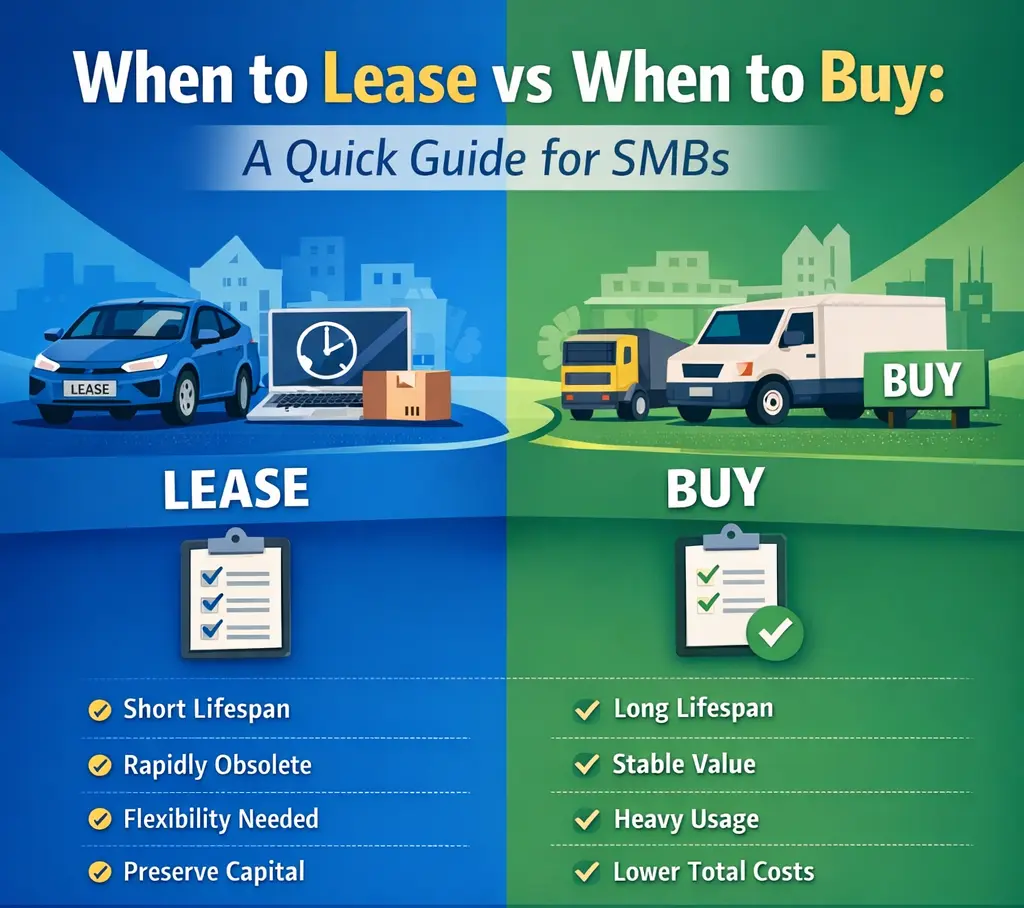
Lease assets that:
- Depreciate quickly
- Become obsolete fast
- Require flexibility
- Protect working capital
Buy assets that:
- Have long useful lives
- Provide stable value
- Lower total cost over extended use
Smart businesses do not choose lease or buy universally. They choose strategically, asset by asset.
Common Mistakes SMBs Make (And How to Avoid Them)
I’ve seen a lot of business owners make expensive mistakes with the lease vs buy decision. Let me share the most common ones so you can avoid them.
Mistake #1: Leasing Everything to “Preserve Cash”
This one drives me crazy because it sounds prudent but often isn’t. Yes, preserving cash is important, especially for young businesses. But leasing EVERYTHING—even assets that would be cheaper to buy—is wasteful.
I worked with a company that leased their office furniture. Desks, chairs, filing cabinets—all leased. They were paying $800 per month for furniture they could have bought for $15,000. Over their five-year lease, they paid $48,000 for furniture worth $15,000, and at the end they owned nothing. Why? Because someone told them to “lease everything to preserve cash.”
The fix: Be strategic. Lease expensive assets with short useful lives or where flexibility matters. Buy inexpensive assets with long useful lives. Run the numbers for each decision rather than applying a blanket rule. Before deciding, review the average cost to lease a copier to accurately compare lease payments with total ownership expenses.
Mistake #2: Buying Assets That Depreciate Rapidly
The opposite mistake: buying technology or vehicles that lose value fast, then being stuck with obsolete or high-mileage assets you can’t easily unload.
A client bought a fleet of luxury vehicles for their sales team because they got a “great deal.” Three years later, those vehicles had depreciated 50%, the sales team wanted newer models to maintain their professional image, and the company was stuck with vehicles worth half what they paid. They couldn’t afford to take the loss to replace them, so their sales team was driving dated vehicles—not a great look in their industry.
The fix: For assets that depreciate rapidly or become obsolete quickly (especially technology and vehicles), seriously consider leasing. The depreciation hit is built into the lease payment, and you’re not stuck with used assets.
Mistake #3: Ignoring Total Cost of Ownership
This is huge. People compare monthly lease payments to loan payments and think that tells the whole story. It doesn’t.
When you buy equipment, add up the purchase price, financing costs, insurance, maintenance, repairs, and eventual disposal costs. Then subtract the resale value. THAT’S your total cost of ownership. Compare that to the total cost of leasing (all lease payments plus any buyout if you keep it, plus any costs not covered by the lease).
Only when you’ve done this analysis can you really know which option is cheaper. Usually buying is less expensive over the full useful life, but not always—and certainly not if you’ll upgrade before then.
The fix: Create a spreadsheet. Model out both scenarios over the expected useful life or your intended use period. Include all costs, not just the obvious ones. Then make an informed decision.
Mistake #4: Not Reading the Lease Agreement Fine Print
Lease agreements can be tricky. Early termination fees, excess wear charges, mileage limits, maintenance requirements, insurance minimums, end-of-lease obligations—these are all in the contract, and they can cost you thousands if you’re not careful.
I watched a business get hit with $12,000 in excess wear charges when returning leased equipment because they hadn’t properly maintained it per the lease terms. They thought normal wear and tear would be fine. It wasn’t. The lease defined “normal” very strictly.
The fix: Read the entire lease agreement before signing. Better yet, have your attorney review it. Understand every obligation and potential cost. Ask questions about anything unclear. Know what happens if you need to terminate early or if you exceed usage limits.
Mistake #5: Making Emotional Decisions
“I want to own it, not rent it” is an emotional position, not a financial one. I get it—there’s pride in ownership. But that emotion can cost you real money.
Conversely, “I’m scared to commit to a purchase” can cause you to overpay for flexibility you don’t actually need. Fear-based decisions are rarely optimal.
The fix: Separate emotion from analysis. Run the numbers objectively. Consider the strategic factors. Then make a rational decision based on what’s best for your business financially and operationally. If ownership or flexibility makes you feel better and the cost difference is small, fine—factor that in. But don’t let emotion override clear financial disadvantages.
Mistake #6: Failing to Plan for End-of-Lease Costs
Many business owners focus on the monthly lease payment and forget about end-of-lease obligations. Excess wear charges, disposition fees, mileage overages, and buyout prices can add thousands to the total cost.
The fix: Before signing a lease, understand all end-of-lease costs and obligations. Budget for them. If you think you’ll exceed mileage limits or use equipment hard, negotiate higher limits upfront or choose a different lease structure. Document equipment condition at lease start so there are no surprises about what constitutes excess wear.
Mistake #7: Not Consulting Professionals
Tax laws are complex. Accounting rules change. Lease agreements contain legal terminology. Many business owners try to figure all this out themselves and make expensive mistakes.
The fix: Before making major equipment decisions, consult with your CPA and attorney. Your CPA can model the tax implications and help you understand the financial impact. Your attorney can review lease agreements and protect you from problematic terms. Yes, this costs money upfront, but it can save you many times that amount in avoided mistakes.
Mistake #8: Focusing Only on Short-Term Costs
“The lease payment is lower than the loan payment, so leasing is cheaper” is flawed logic. You’re comparing different things—temporary use vs. ownership.
Looking only at what your cost is this year or this month can lead you to lease when buying would be substantially cheaper over time. If you’ll use equipment for its full useful life, buying is almost always less expensive total cost, even if monthly costs are higher.
The fix: Look at the full time horizon. How long will you use this equipment? What’s the total cost over that period for each option? Make decisions based on total cost over your expected use period, not just this year’s budget impact.
Mistake #9: Treating All Assets the Same
Different asset types have different characteristics that affect the lease vs buy calculus. Treating your IT equipment the same as your delivery vehicles the same as your real estate doesn’t make sense.
The fix: Evaluate each asset type—and sometimes each specific asset—individually. Consider depreciation rate, useful life, how quickly it becomes obsolete, how you’ll use it, and your likely upgrade timeline. Make decisions asset by asset.
Mistake #10: Not Reassessing Periodically
The right decision when you’re a two-year-old startup might be the wrong decision when you’re a ten-year-old established company. Your financial position changes, your needs evolve, and your strategy should too.
The fix: Review your asset acquisition strategy annually. Are you still making the right lease vs buy decisions given your current situation? As leases expire, reassess whether leasing again is the right move or if buying now makes more sense. Don’t just auto-renew leases or automatically buy again without evaluating your options.
Making Your Decision: A Strategic Framework
Alright, we’ve covered a ton of ground. Now let’s bring it all together with a practical framework you can use to make smart lease vs buy decisions for your specific situation.
The 5 Critical Questions
Before diving into calculations, ask yourself these five questions. Your answers will guide your decision.
1. How long will I use this asset?
If you’ll use it for its entire useful life or close to it, buying usually wins financially. If you’ll upgrade or replace it before then, leasing often makes more sense. Be honest with yourself here—don’t convince yourself you’ll use something for ten years if you’ll really want the newer version in five.
2. How important is cash flow flexibility right now?
If preserving cash is critical for growth, opportunities, or survival, lean toward leasing even if buying would be cheaper long-term. Cash today is worth more than savings over five years if you need that cash to operate. But if you have healthy reserves and strong cash flow, don’t overpay for flexibility you don’t need.
3. How rapidly will this asset depreciate or become obsolete?
Fast depreciation or obsolescence favors leasing. Stable value or appreciation favors buying. Technology? Lease. Real estate? Buy. Vehicles depend on how you use them. Specialized manufacturing equipment? Usually buy.
4. How predictable are my needs?
High certainty about your future needs and how you’ll use the asset favors buying. Uncertainty about growth, space requirements, or business direction favors leasing. Startups should lease more; established businesses can buy more.
5. What’s my exit strategy and timeline?
If you’re building a business to sell in 3-5 years, consider how lease obligations vs. owned assets affect business value and attractiveness to buyers. If you’re building a multi-generational business, long-term cost savings from ownership matter more.
Creating Your Decision Matrix
Now let’s get structured. Create a simple decision matrix for each major equipment decision:
Financial Analysis:
- Total cost to own (purchase price + financing + insurance + maintenance + disposal – residual value)
- Total cost to lease (all lease payments + end costs + maintenance not covered)
- Net difference
- Cash flow impact (upfront costs and monthly costs for each option)
- Tax implications (consult your CPA for your specific situation)
Strategic Factors:
- Useful life vs. intended use period
- Obsolescence risk (low/medium/high)
- Flexibility value (how likely is it I’ll need to change?)
- Maintenance complexity (can I handle this, or do I want the lessor to?)
- Impact on borrowing capacity
Risk Factors:
- Financial risk if the asset doesn’t work out
- Obsolescence risk
- Repair cost risk
- Residual value risk (if buying, will it be worth what I think?)
Rate each factor, weight them based on importance to you, and see which option scores better overall.
When Hybrid Approaches Make Sense
You don’t have to choose one strategy for everything. The smartest businesses mix leasing and buying strategically:
- Lease: Technology, vehicles (if you prefer newer), rapidly evolving equipment, seasonal equipment, equipment you’re not sure you’ll need long-term
- Buy: Real estate (when appropriate), furniture, basic tools, specialized equipment you’ll use forever, assets with stable value
This hybrid approach gives you flexibility where it matters while building equity in assets that hold value. It’s not wishy-washy—it’s strategic.
Getting Quotes: What to Look For
When you’re ready to get serious, gather quotes for both leasing and purchasing:
For Lease Quotes:
- Monthly payment and term length
- Security deposit and upfront costs
- What’s included (maintenance, insurance, etc.)
- Mileage or usage limits and overage charges
- End-of-lease options (return, purchase, extend)
- Early termination penalties
- Excess wear definitions and charges
- Documentation and disposition fees
Note: If leasing makes sense for your strategy, researching the best copier lease companies near you ensures competitive pricing and strong service terms.
For Purchase Quotes:
- Total price (including all fees)
- Financing terms (rate, term, down payment)
- Warranty coverage
- Maintenance and service options
- Insurance costs
- Expected residual value at end of use period
Get quotes from multiple providers for both options. Rates and terms vary significantly, and competition works in your favor.
Negotiation Strategies
Everything is negotiable, whether leasing or buying. Here’s what to push on:
Leasing:
- Residual value (higher residual = lower payment but higher buyout)
- Money factor (interest rate)
- Mileage or usage limits
- Wear and tear standards
- Maintenance package inclusion
- Security deposit amount
- End-of-lease buyout terms
Buying:
- Purchase price (obviously)
- Financing rate and terms
- Down payment requirements
- Included warranties or service
- Delivery and setup costs
- Trade-in values on existing equipment
Don’t accept the first offer. If you’re a good credit risk and buying substantial equipment, you have leverage. Use it.
Building Your Long-Term Strategy
Don’t make one-off decisions in a vacuum. Develop an asset acquisition strategy aligned with your business plan:
Years 1-3: Minimize capital tied up in assets. Lease most things. Focus cash on growth.
Years 4-7: Start building equity in assets you know you’ll need long-term. Mix of leasing and buying.
Years 8+: Shift more toward buying to reduce ongoing costs and build business value. Still lease technology and vehicles if that makes sense.
Adapt based on performance: If growth is faster than expected, maintain flexibility by continuing to lease more. If you’re more stable than expected, accelerate the shift to buying.
Review Periods: When to Reassess
Set calendar reminders to review your asset strategy:
- Quarterly: Review upcoming lease expirations and make decisions about renewal, buyout, or return
- Annually: Assess your overall strategy. Is your mix of leasing and buying still appropriate?
- At major business milestones: Significant revenue growth, major contracts, expansion to new locations, ownership changes
Don’t just let leases auto-renew or automatically replace equipment the same way you acquired it last time. Consciously decide each time.
The Decision Tree
Here’s a simple decision tree to guide you:
START: Do I need this asset?
- No → Don’t acquire it
- Yes → Continue
Will I use it for its entire useful life (or close to it)?
- Yes → Lean toward BUYING
- No → Continue
How rapidly does it depreciate/become obsolete?
- Rapidly → Lean toward LEASING
- Slowly → Continue
Is cash flow tight?
- Very tight → LEASE
- Comfortable → Continue
Do I need flexibility to change/upgrade?
- High need → LEASE
- Low need → Continue
Does the total cost analysis favor buying?
- Yes, significantly → BUY
- Close or favors leasing → LEASE
This isn’t a perfect algorithm, but it’s a good starting point for thinking through your decision logically.
Final Thoughts on Asset Based Lease vs Buy Decisions
The lease vs buy decision is not one size fits all. It changes depending on the asset type, usage intensity, technological pace, and your business growth trajectory.
The key is to run the numbers for YOUR situation. Calculate the total cost of ownership, consider your tax position, evaluate your cash flow needs, and think about where your business will be in three to five years. Factor in depreciation, obsolescence risk, maintenance costs, and flexibility value. Don’t just follow what other businesses do—make the choice that positions you for sustainable growth and financial health.
Ready to make the best decision for your business? Start by getting quotes for both leasing and purchasing your next major asset. Crunch the numbers with the framework I’ve provided, consult with your financial advisor and CPA, and choose the path that aligns with your strategic vision. Consider not just the immediate cost, but the total impact over time.